
Key takeaways
- Treat project management as a strategic discipline, not an administrative afterthought.
- Break vague tasks into granular components to identify potential bottlenecks early.
- Operational excellence enables more ambitious marketing and better business results.
When Marketing Strategy Meets Operational Reality
You know the feeling. Your campaign launch date is locked in, stakeholders are waiting for results, and suddenly everything starts unraveling. The creative team needs “just two more days” for revisions, a compatibility issue surfaces that should have been caught weeks ago, and your social media rollout is scrambling to catch up with a delayed landing page.
Marketing teams consistently struggle with campaign execution despite having strong strategic capabilities. The symptoms are familiar: missed launch dates that force expensive last-minute media adjustments, quality compromises when rushing to meet deadlines, team burnout from constant firefighting, and revenue impact from delayed seasonal campaigns.
Consider a holiday campaign that gets delayed by two weeks. Not only are you facing increased media costs as premium placements fill up, but you’re also launching a rushed, poorly optimized campaign that misses the critical early holiday shopping period when consumers are most receptive to new messaging. The campaign launches in a compromised state – shortened testing phases, reduced quality assurance, and creative elements that weren’t properly refined – right when competition is fiercest and your message needs to be strongest.
The Root Causes Behind Marketing Delays
Most marketing teams treat project management as an administrative afterthought rather than a strategic discipline. They create basic timelines without accounting for dependencies, underestimate coordination time between creative and technical teams, and rely on email chains for complex campaign coordination. The planning often fails to account for review cycles, approvals, and the inevitable revision rounds that extend timelines.
The challenge runs deeper than poor planning. Marketing operations involve professionals with fundamentally different approaches to work. Creative teams think in concepts and iterations, while technical teams focus on specifications and testing protocols. Media teams work with external deadlines and vendor schedules, and analytics teams require data integration and tracking setup time. Without structured coordination, these different working styles create bottlenecks and miscommunication.
Marketing campaigns also face numerous potential disruptions that teams rarely plan for systematically. Third-party data integration delays, creative approval bottlenecks, technical compatibility issues, external vendor schedule changes, and regulatory review requirements can all derail carefully planned timelines. Teams that don’t anticipate these risks find themselves constantly reacting to problems instead of preventing them.
The Solution: Applying Project Management Methodology to Marketing Operations
The transformation begins with implementing work breakdown structures that convert vague tasks into manageable components. Instead of treating “create social media content” as a single task, you break it down into content strategy development, copywriting and messaging, visual design and asset creation, internal review and approval cycles, platform scheduling and optimization, and performance tracking setup. This granular approach helps identify potential bottlenecks before they threaten deadlines.
Communication protocols become the foundation for reliable execution. Successful marketing operations require structured stakeholder management, usually through weekly checkpoint meetings to catch issues early. Signs of an organized team are standardized briefing formats for messages and meetings, progress dashboards that provide real-time visibility, and clear escalation paths for decision-making.
Professional project managers build in strategic buffer time because they know campaigns rarely go exactly as planned. Maybe your designer gets pulled onto another urgent project, or the client wants to see three more creative variations, or the landing page takes longer to build than expected. Smart planners account for these realities upfront rather than scrambling when they happen.
Quality assurance checkpoints prevent the compromises that typically occur under deadline pressure. Instead of rushing creative concepts to market, you build in review points where stakeholders can provide feedback before it’s too late to act on it. Technical elements get tested before launch day, not during it. These planned checkpoints keep campaign quality high even when timelines are tight.
Key Benefits: How PM Methodology Improves Marketing Outcomes
When teams aren’t constantly rushing to meet deadlines, campaign quality improves dramatically. They can conduct thorough A/B testing on creative elements, implement comprehensive quality assurance processes, optimize technical implementation for better performance, and develop more sophisticated measurement and attribution strategies.
Resource utilization becomes more strategic because you can finally see conflicts before they happen. When you know your graphic designer is committed to three other projects next month, you can plan accordingly or bring in additional help. When vendors understand your professional approach to project management, they’re more willing to accommodate your timelines and often provide better rates for reliable clients.
The operational discipline builds stronger stakeholder relationships across the organization. Marketing teams earn greater trust from leadership when they consistently deliver on commitments. Other departments become more willing to collaborate when they know marketing operations are reliable. Even external vendors provide better service to dependable clients and campaign results improve due to consistent execution quality.
Perhaps most importantly, operational excellence enables more ambitious marketing initiatives. Complex multi-channel campaigns become feasible when you have the operational discipline to coordinate them effectively. Integrated product launches can be executed reliably, sophisticated testing programs deliver actionable insights, and international campaign coordination becomes manageable rather than chaotic.
Implementation Strategy: Getting Started with Marketing Project Management
The path forward involves a phased approach that builds capabilities progressively. Start with an assessment phase where you audit current campaign management processes and identify your biggest recurring bottlenecks. This is also when you’ll want to implement basic project tracking tools and establish regular team coordination meetings. Allow for around one month for this initial phase in total.
The next phase focuses on developing standardized processes. Over the following two to three months, you’ll create campaign planning templates and work breakdown structures for your most common campaign types. Documentation of clear roles and responsibilities becomes crucial here, along with risk planning protocols that help teams anticipate common disruptions before they derail timelines.
Advanced optimization comes later, typically around months four through six. This involves deploying integrated project management platforms and creating cross-campaign resource planning capabilities. You’ll also develop predictive timeline modeling and establish feedback loops for continuous improvement based on real campaign experience.
Measuring Success: Marketing Operations KPIs
Success requires tracking both operational and business metrics to ensure that improved processes actually support better marketing outcomes. Operational metrics include on-time campaign delivery percentage, average time from brief to launch, resource utilization rates, and quality gate pass rates.
Business impact metrics should also be closely measured to demonstrate the value of operational improvements. Campaign performance improvements, cost per acquisition trends, team satisfaction and retention, and stakeholder satisfaction scores all provide insight into whether your enhanced marketing operations are driving meaningful business results.
The Bottom Line
Marketing teams that apply structured project management methodology consistently deliver campaigns on time, within budget, and at higher quality levels. This operational foundation enables focus on strategic work that drives measurable business results rather than constant crisis management.
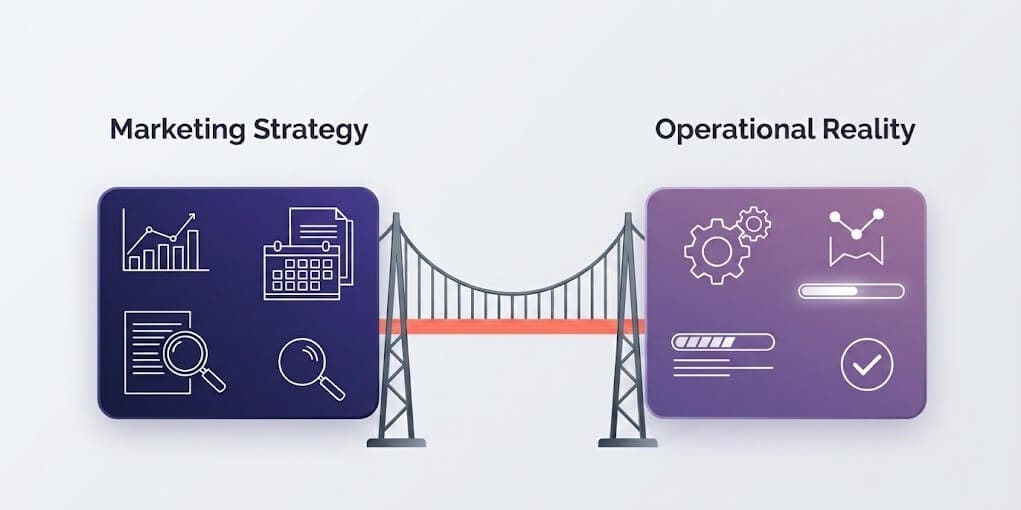
The question isn’t whether your team has strong marketing expertise. It’s whether your operational foundation supports turning that expertise into reliable, scalable campaign success. When you bridge the marketing-operations gap, you unlock your team’s full potential to drive business growth through consistently excellent campaign execution.
Ready to transform your marketing operations? Let’s discuss how proven project management frameworks can be adapted to your team’s specific challenges and campaign requirements.

About the Author
Erik is a marketing leader and PMP-certified professional who blends technical IT roots with digital growth strategy. He spent over a decade driving growth for global enterprise organizations and brings that same rigor to SEO and advertising today. He is passionate about connecting high-level strategy to technical execution to deliver the clear, measurable outcomes your business actually needs.