
Key takeaways
- Prioritize strategic process mapping over AI tool selection.
- Combine human strategic thinking with AI execution efficiency.
- Treat AI implementation as a continuous operational improvement project.
Walk into marketing conferences today and you’ll hear similar conversations happening at coffee breaks. Someone’s raving about their new AI writing tool, while someone else complains that AI content “just doesn’t work” for their business. Both perspectives miss the real story unfolding in content marketing right now.
What’s interesting about the current AI content marketing landscape is how similar the available tools are, yet how dramatically different the results can be. Some businesses see immediate improvements in both efficiency and content quality, while others struggle to justify their AI tool subscriptions after months of use.
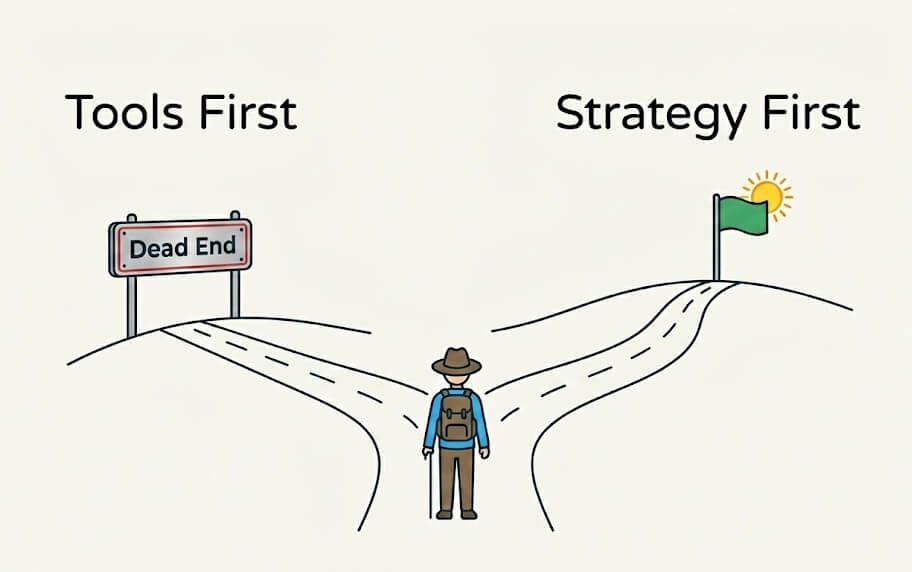
The businesses achieving real success treat AI implementation like any other operational improvement project. They map their current processes, identify specific problems, and deploy solutions systematically. The ones disappointed with AI results typically buy tools first and figure out strategy later.
The Real Problem Isn’t Tool Selection
Most marketing teams approach AI content marketing by researching tools. They’ll spend weeks comparing features between different AI writing platforms, reading reviews, and testing free trials. Then they subscribe to their chosen tool and expect immediate improvements in their content marketing results.
Three months later, they’re disappointed with the results. Blog traffic hasn’t budged despite publishing more frequently. Content production still feels time-consuming even with AI assistance. The disconnect happens because implementation approach matters more than tool selection – teams layer AI onto existing problems without addressing underlying strategic gaps.
Consider what happens when you layer AI tools onto existing content problems. If your current content lacks clear objectives, AI will efficiently produce more unfocused content. If your topics don’t align with what your audience actually wants to read, AI will help you create more irrelevant posts faster. If your content doesn’t support your business goals, AI will accelerate the production of content that doesn’t drive results.
AI tools amplify whatever content strategy you already have in place. When that strategy is solid, AI can create remarkable improvements in both efficiency and results. When the underlying strategy has gaps, AI makes those gaps more visible and more expensive.
What Actually Drives AI Content Success
The businesses seeing transformative results from AI content marketing share characteristics that have nothing to do with their tool choices. They approach AI implementation with clear content objectives already tied to specific business outcomes. Their understanding of audience needs and systematic content processes existed before AI entered the picture.
What sets these businesses apart is how they view AI – as an execution enhancer working within existing strategy rather than a replacement for strategic thinking. Consider a marketing team that already knows which topics resonate with their audience and maintains content calendars aligned with campaign priorities. When they introduce AI tools, those tools accelerate execution of proven strategies.
The improvements can be dramatic when AI integrates into well-designed operations. Research tasks that previously consumed entire mornings now happen in twenty minutes. Content adaptation across multiple social platforms becomes automated rather than requiring separate writing sessions for each channel.
Speed and volume improvements only create business value when the accelerated content actually drives engagement, builds authority, or generates leads. Producing unfocused content faster doesn’t solve content marketing challenges.
The Implementation Gap Everyone Ignores
Here’s what I observe when businesses implement AI content tools without systematic planning. They experience initial excitement as AI helps them produce content faster than before. Blog posts that took four hours to write now take 45 minutes. Social media captions that required 20 minutes of brainstorming now generate in two minutes.
Then reality sets in. The faster content production doesn’t translate to better marketing results. Website traffic doesn’t increase proportionally to content volume. Social media engagement doesn’t improve despite more frequent posting, and lead generation doesn’t accelerate even with more blog content published.
The gap between AI capability and business results happens at the implementation level. Teams use AI to optimize individual tasks without considering how those tasks fit into broader marketing operations. They might generate blog outlines quickly but don’t ensure those outlines support SEO keyword strategies. Social media captions get created efficiently, but nobody verifies that captions align with campaign messaging.
Systematic AI implementation requires understanding your current content creation workflow before introducing AI solutions. Document each step from initial topic identification through final publication and promotion. Identify where bottlenecks slow down content production, where quality inconsistencies create extra revision cycles, and where scaling demands strain available resources.
Then evaluate which specific challenges AI tools can address within your existing workflow. The goal isn’t hoping AI will create entirely new workflows that somehow work better – it’s understanding where AI fits into what you’re already doing.
The Quality Control Challenge
One of the biggest obstacles businesses face with AI content marketing is maintaining quality standards while gaining efficiency benefits. AI can produce content volume quickly, but that content requires systematic review and optimization to meet brand standards and achieve marketing objectives.
Many teams approach AI content quality control reactively. They generate AI content, then try to edit it into acceptable shape afterward. This approach often eliminates the efficiency benefits AI was supposed to provide – extensive editing and revision cycles can make AI-assisted content take just as long to produce as manual content creation.
The businesses achieving both efficiency and quality improvements think about AI content quality control proactively. They establish clear guidelines about what AI should handle independently and what requires human oversight. Their workflows incorporate both AI efficiency and human expertise at appropriate points in the content creation process.
AI might excel at generating initial research summaries, content outlines, and first drafts. Human experts focus on strategic messaging alignment, brand voice consistency, and optimization for specific business objectives. This division of labor requires planning, but it enables both faster content production and better final quality.
Why Content Strategy Still Comes First
The businesses most disappointed with AI content marketing results typically have one thing in common – they hoped AI would solve content strategy problems they hadn’t addressed manually. They wanted AI to identify what topics they should write about, determine what messaging would resonate with their audience, and figure out how content should support their business goals.
AI can provide data insights and content suggestions, but it can’t replace strategic thinking about what your business needs to communicate and why. Content strategy involves understanding your competitive landscape, knowing your audience’s journey from awareness to purchase, and connecting content topics to business outcomes.
When content strategy foundation exists, AI becomes a powerful execution amplifier. AI can identify content gaps in your topic coverage and suggest variations on high-performing content themes. It can help adapt successful content for different audience segments or distribution channels. And AI works best when it’s enhancing strategic decisions that humans have already made thoughtfully.
Common Early Mistakes to Avoid
The most common mistake businesses make with AI content implementation is using AI to automate processes that weren’t working well manually. If your content creation lacks clear objectives or systematic quality control, AI will efficiently produce more of the same unfocused content you were creating before.
Another frequent error is implementing multiple AI tools simultaneously without integration planning. Teams end up managing several different AI platforms that don’t communicate effectively with each other, creating coordination overhead that eliminates productivity benefits.
Many businesses also underestimate the learning curve required for effective AI tool utilization. AI content tools work best when users understand both their capabilities and their limitations. This requires training investment and systematic experimentation to develop effective AI-assisted workflows.
Teams often expect immediate results from AI implementation without allowing time for process optimization. Like any operational improvement, AI content marketing requires refinement based on early results and feedback. The businesses seeing the best long-term results treat initial AI implementation as a learning phase rather than expecting optimal performance immediately.
What Success Actually Looks Like
Successful AI content marketing doesn’t look like completely automated content production. It looks like content operations that combine human strategic thinking with AI execution efficiency to produce both more content and better results than either approach could achieve independently.
Teams working effectively with AI content tools report that their content planning becomes more strategic because AI handles routine execution tasks, freeing time for higher-level thinking. Their content quality becomes more consistent because AI helps maintain brand voice and formatting standards across all content pieces.
What matters most is that their content marketing results improve because AI enables them to execute their content strategy more completely. They can adapt high-performing content for multiple channels, test different messaging approaches, and maintain consistent publishing schedules that support their broader marketing campaigns.
The goal isn’t replacing human expertise with AI automation – it’s combining human strategic thinking with AI execution capabilities to create content marketing operations that are both more thoughtful and more scalable than traditional approaches allow.

About the Author
Erik is a marketing leader and PMP-certified professional who blends technical IT roots with digital growth strategy. He spent over a decade driving growth for global enterprise organizations and brings that same rigor to SEO and advertising today. He is passionate about connecting high-level strategy to technical execution to deliver the clear, measurable outcomes your business actually needs.