
Key takeaways
- Treat marketing automation as a technical project, not a campaign.
- Prioritize robust data architecture over platform features and functions.
- Ensure long-term maintainability through rigorous system mapping and documentation.
The marketing team finally gets budget approved for a marketing automation platform. Everyone’s excited about the possibilities – automated lead nurturing, personalized campaigns at scale, hours of manual work eliminated. Six months later, the tool sits mostly unused. The team is frustrated. Leadership questions the investment.
Sound familiar?
Marketing automation projects fail at predictable rates, and it’s rarely because teams chose the wrong platform. They fail because implementation requires technical thinking that marketing teams often don’t have, and technical teams don’t understand the marketing requirements.
A team implements email automation but can’t connect it properly to their CRM. Lead scoring rules don’t align with how sales actually defines qualified leads. Workflows trigger incorrectly because nobody mapped the technical dependencies first. The automation creates more chaos than it solves, and eventually everyone goes back to manual processes.
Having built marketing automation systems across multiple platforms, the same implementation gaps appear repeatedly. Understanding these patterns helps explain why some automation implementations thrive while others become expensive lessons in what not to do.
The Implementation Gap Nobody Talks About
Marketing automation requires systems thinking, not just marketing knowledge. Teams often approach it like they would a creative campaign – vision, strategy, execution. They should approach it like a technical integration project that happens to serve marketing goals.
Several patterns consistently emerge in failed implementations.
Implementation without proper data architecture planning creates problems immediately. Teams build workflows before cleaning their data foundation. You can’t automate decisions on unreliable data. Garbage in, garbage out happens at scale when you automate bad processes.
Tool selection based on impressive features rather than integration requirements leads to buyer’s remorse. A platform might have amazing capabilities, but if it can’t connect to your existing tech stack properly, those features become irrelevant. Integration complexity often exceeds tool complexity. A platform might take two weeks to learn but six months to connect properly to your existing CRM, analytics, and sales systems.
Workflow design without technical dependency mapping causes mysterious failures. Marketing workflows have technical requirements – API rate limits, data synchronization timing, error handling procedures. When teams design flows without considering these constraints, implementations break under real-world conditions in ways that are difficult to diagnose.
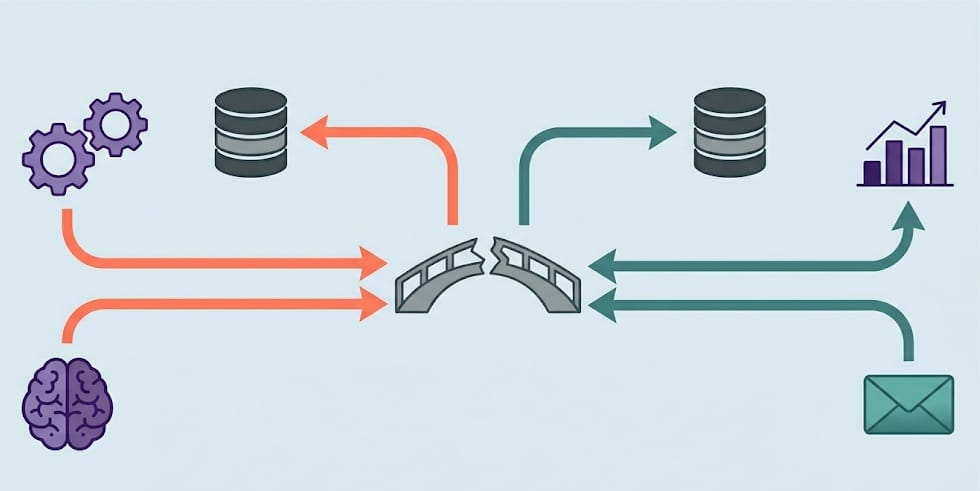
The gap between marketing vision and technical execution is where automation projects die. Bridging this gap requires someone who understands both marketing strategy and technical implementation. Without that bridge, marketing teams design workflows that can’t be built, and technical teams build systems that don’t serve marketing needs.
A team creates lead nurturing based on behavioral scoring, for instance. Sounds great strategically. But the tracking pixels aren’t implemented correctly, so half the leads never trigger workflows because the technical foundation wasn’t built first. The marketing strategy was sound. The technical execution was incomplete.
Building Automation That Actually Functions
Successful automation follows systematic implementation patterns that prevent common failures.
Start with data architecture, not workflows. Before building a single automation, audit your data quality and structure. Do you have clean contact data? Are custom fields properly defined across systems? Can platforms share data reliably? Automation amplifies data problems exponentially. Fixing them after implementation costs far more than fixing them first.
Map your technical dependencies before designing workflows. Which systems need to communicate? What’s the data flow direction? Where are potential bottlenecks or failure points? This technical blueprint prevents the frustrating “it worked in testing but breaks in production” problem that derails many implementations.
Build integration infrastructure before automation logic. Connect your platforms, test data synchronization thoroughly, establish error monitoring systems. When your CRM, email platform, and analytics tools communicate reliably, automation becomes straightforward. Without solid integration, even simple workflows become maintenance nightmares that consume more time than they save.
Design workflows with failure states and edge cases in mind from the beginning. What happens when an API call fails? How do you handle incomplete data? What’s the fallback when expected conditions aren’t met? Technical implementation means planning for everything that can go wrong, not just the happy path where everything works perfectly.
Automation sophistication should match technical maturity. Don’t build complex multi-touch attribution systems before you can reliably track single conversions. This sounds obvious, but teams frequently skip foundational capabilities because they’re boring compared to advanced features.
Start with simple, high-value automations that build confidence. A basic lead scoring system that actually works delivers more value than an elaborate nurturing sequence that constantly breaks. Build technical competence before increasing complexity. Each successful simple automation provides learning that makes the next implementation smoother.
What IT Knows That Marketing Doesn’t
Several technical considerations prevent common failures, but marketing teams often don’t know to ask about them.
API rate limits and data synchronization timing matter more than marketing teams expect. APIs (the connections between platforms) have built-in speed limits to prevent system overload. When you trigger a thousand workflow actions simultaneously, those connections throttle requests – like traffic slowing when too many cars hit the highway at once.
Here’s what happens in practice: You launch a webinar campaign. Five hundred people register at once. Your automation tries to send welcome emails, update your CRM, add people to nurture sequences, and trigger Slack notifications simultaneously. The APIs hit their limits. Some emails send, some don’t. Some CRM records update, others don’t. Your team can’t figure out why half the registrants didn’t get the welcome email – the workflow appears to have run successfully.
Understanding these limits prevents the mysterious “some workflows work perfectly while others fail randomly” problems that plague implementations. Timing matters because data needs to sync between systems before workflows can act on it.
Error logging and monitoring systems separate functioning automation from automation that only appears to function. Marketing teams often can’t tell when automations partially fail because they lack proper monitoring infrastructure. Workflows appear to run successfully, but data doesn’t sync correctly, emails don’t actually send, or scoring doesn’t update. Without monitoring, these silent failures go undetected until someone notices leads aren’t being nurtured or opportunities are being missed.
Testing environments and version control prevent the common “I changed something and broke everything” scenario. Technical teams test changes in staging environments before deploying to production. Marketing teams often edit live workflows directly, creating unpredictable behavior that’s difficult to troubleshoot. When something breaks, nobody knows what changed or how to roll back safely.
Documentation and system mapping seem tedious until someone leaves the company and nobody understands how the automation actually works. Teams can’t modify or fix workflows they don’t understand. Technical documentation isn’t optional administrative work. It’s what makes automation maintainable over time rather than a black box nobody dares touch.
These technical requirements aren’t extra work. They’re what separates automation that works from automation theater where tools are technically implemented but don’t deliver business value.
Making Automation Work
Marketing automation fails when teams treat it as a marketing project. It’s actually a technical implementation project that serves marketing goals.
The difference between automation that works and automation that collects dust comes down to technical execution. Proper data architecture, solid integration infrastructure, systematic testing protocols, and error monitoring systems aren’t optional nice-to-haves. They’re the foundation that makes everything else possible.
When evaluating automation projects, ask about implementation approach rather than just platform features. The teams who understand technical requirements and can bridge the gap between marketing strategy and technical execution are the ones who actually deliver results. Platform capabilities matter, but implementation quality determines whether those capabilities ever get used effectively.

About the Author
Erik is a marketing leader and PMP-certified professional who blends technical IT roots with digital growth strategy. He spent over a decade driving growth for global enterprise organizations and brings that same rigor to SEO and advertising today. He is passionate about connecting high-level strategy to technical execution to deliver the clear, measurable outcomes your business actually needs.